Empty it and check the dates
Everything comes out onto the counter. You will throw away more than you expect — most pantries are holding several years of half-used baking supplies and at least one thing nobody remembers buying.
Check every date as it comes out. Doing it now means you never have to do it again mid-week while cooking.
Group by how you cook, not by food type
Supermarket logic is the wrong logic for a home. Grouping by "tins" and "jars" means a single weeknight dinner sends you to four different shelves.
Group by occasion instead: breakfast, lunchboxes, baking, pasta night, snacks. The test is whether one meal comes from one zone. If it does, the pantry works.
Put things at the right height
Eye level is prime property and it should go to whatever you reach for daily. Bulk, rarely-used appliances and holiday things go above. Anything the children are allowed to take themselves goes at the bottom, where they can reach it without climbing.
That last one is worth the whole exercise. A snack bin a four-year-old can reach ends a surprising amount of daily friction.
Decant only what earns it
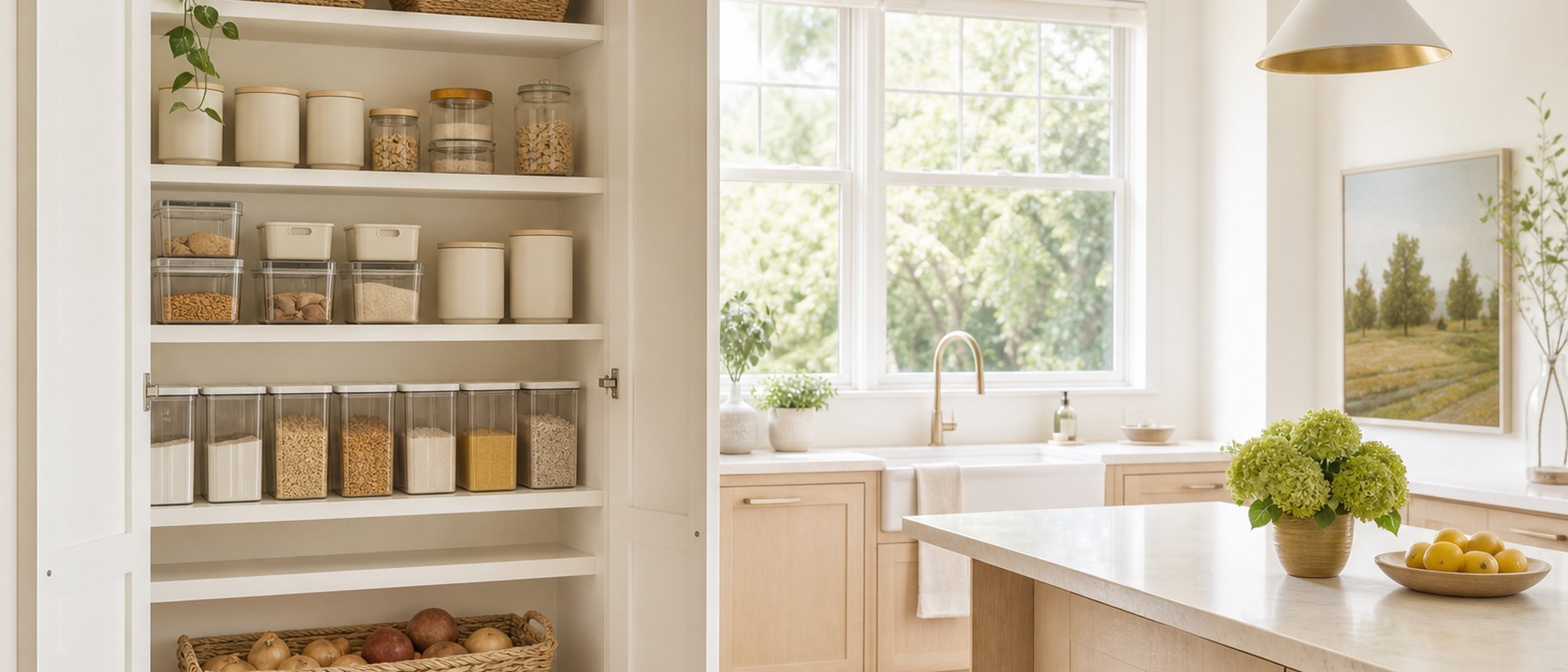
Decanting is overprescribed. For flour, rice, pasta, cereal and sugar it genuinely helps: you can see the level, the bags stop collapsing, and the shelf stops being sticky.
For nearly everything else it adds a chore to every shop and the pantry quietly stops being maintained. Decant five or six staples, leave the rest in their packaging.
Contain the small things
Packets, sachets and sauce sachets are what turn a tidy shelf back into a pile. They have no structure, so they need borrowed structure — one bin per category, and the bin is the address.
Measure your shelves before buying anything. Bins that are an inch too deep are the most common wasted purchase in home organizing.
Leave a landing space
Every working pantry needs one shelf or one bin that is deliberately left empty. It is where the shop lands before it is put away, and where the overflow goes when you buy two of something on offer.
Pantries without a landing space stay tidy right up until a big shop, then collapse — because there is nowhere for the new things to go except on top of the old ones.
Front-face the shelves, and rotate
Pull everything forward to the shelf edge so labels face out. It takes thirty seconds and it is most of what makes a pantry look professionally organized in photographs.
When you unpack a shop, new stock goes behind the old. Without that habit you end up with three open jars of the same thing and one that expired a year ago at the back.
Deep shelves need pull-outs
On a shelf deeper than about fourteen inches, anything behind the front row effectively stops existing. You will buy a third jar of cumin because you cannot see the two already there.
Bins you can pull out like a drawer, or a turntable in a corner, turn that dead depth back into usable storage. This is the one place where buying a container genuinely solves a problem rather than relocating it.
Label it, because the pantry is not just yours
Labels are not decoration. They are how everyone else in the house — and the person unpacking the shop at speed — knows where something goes.
An unlabelled system is a system only you can maintain, which means it is a system that will fail the first week you are busy.